

How School Hiring Managers Are Responding to Teacher Shortages in 2026-2027
For years, the conversation around K-12 staffing has focused on vacancies.
Schools need more special education teachers. Speech-language pathologists are difficult to find. School psychologists remain in short supply. Districts compete for a limited pool of qualified professionals.
None of that is new.
What’s changing is how school leaders are responding.
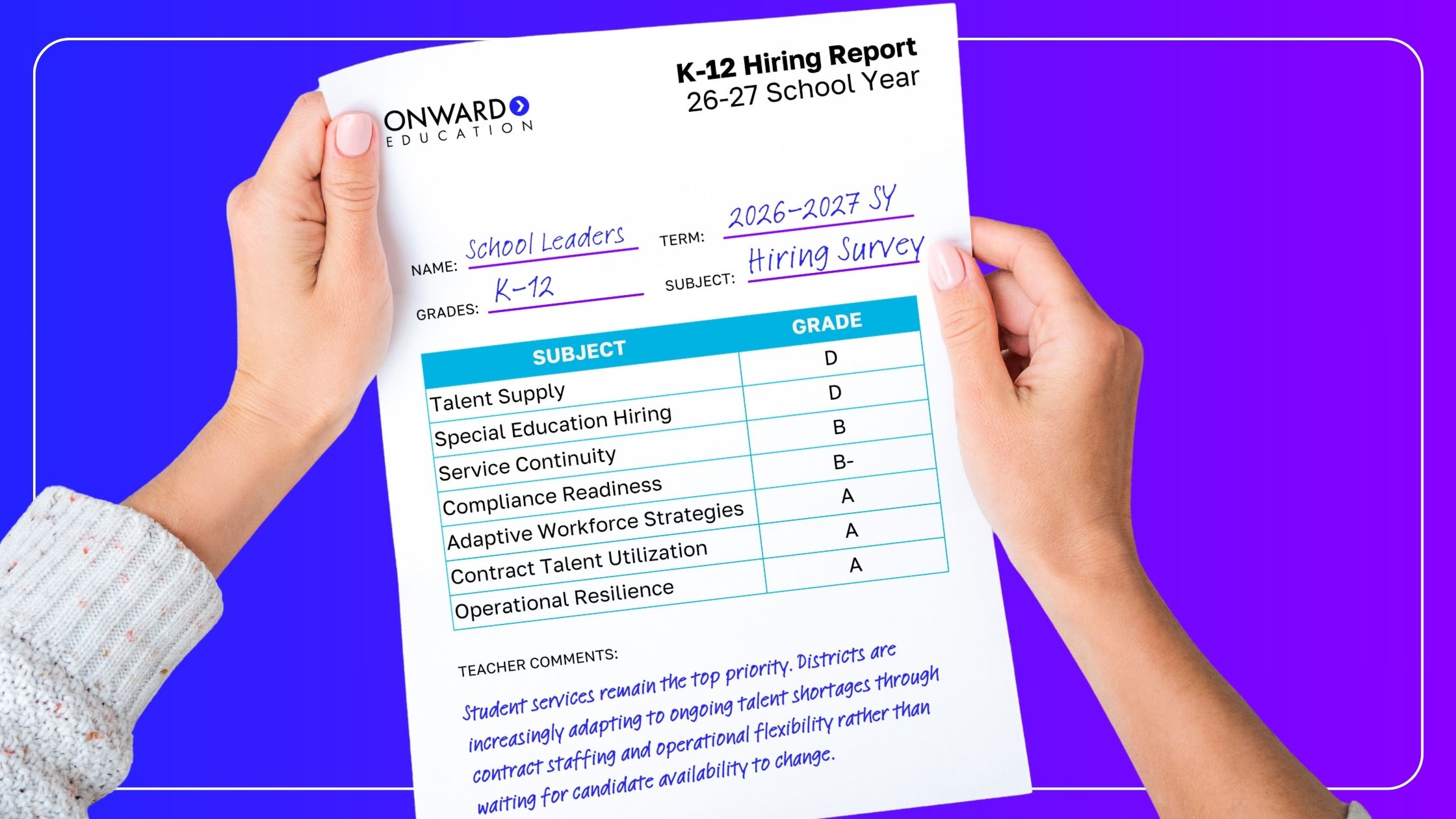
Onward Education recently surveyed K-12 leaders across the country to better understand hiring challenges and workforce planning for the 2026-2027 school year. While the survey confirmed ongoing shortages in specialized student support roles, the more interesting finding was this:
Districts are no longer planning for a return to normal. They’re adapting their workforce strategies around the expectation that talent shortages will continue.
If you’re a hiring manager or responsible for staffing decisions, keep reading to learn how schools are maintaining student support despite ongoing hiring challenges.
Survey Highlights
- 85% identified special education teachers as one of their most difficult positions to fill
- 70% cited a shortage of qualified candidates as a primary staffing challenge
- 75% plan to use contract professionals during the 2026-2027 school year
- 60% are starting recruitment earlier
- 55% said vacancies threaten required student services
- 50% cited staff burnout as a major consequence of unfilled positions
The Staffing Challenge Has Become an Operations Challenge
The data suggests that vacancies are no longer viewed simply as a recruiting problem.
When school leaders discussed the impact of unfilled positions, their concerns centered on service delivery, staff workload, compliance, and operational disruption.
More than half of respondents indicated that vacancies threaten their ability to provide required student services, while 50% cited increased staff workload and burnout as a major consequence of unfilled positions.
In other words, district leaders aren’t just asking:
“How do we fill this position?”
They’re asking:
“How do we maintain services if this position remains vacant?”
That shift in thinking has significant implications for workforce planning.
Special Education Remains the Greatest Pressure Point
When asked which roles are most difficult to fill, 85% of respondents identified special education teachers.
Speech-language pathologists, school psychologists, behavioral specialists, and nursing professionals also ranked among the most difficult positions to staff.
These shortages create unique challenges because they directly affect student support services, IEP implementation, evaluations, behavioral interventions, and other critical functions.
Unlike some vacancies that can be absorbed temporarily, shortages in specialized service roles often have immediate implications for students and district operations.
Districts Are Changing Their Playbook
Perhaps the most revealing finding from the survey was not where shortages exist, but how districts are responding.
The most common strategies included:
- Starting recruitment earlier (60%)
- Expanding the use of contract staffing (55%)
- Increasing compensation and incentives (30%)
- Expanding teletherapy and virtual services (20%)
What’s notable is that districts were more likely to focus on workforce flexibility than compensation alone.
The challenge appears to be less about attracting talent through higher pay and more about finding ways to deliver services when qualified professionals are simply not available in sufficient numbers.
This represents a meaningful shift from traditional staffing approaches.
Contract Staffing Is Becoming Strategic
A key finding from the survey is that 75% of respondents plan to use contract professionals in some capacity during the 2026-2027 school year.
Most are not using contract staff to replace their permanent workforce.
Instead, districts are leveraging contract professionals to:
- Fill specialized roles that remain difficult to recruit
- Support high-need service areas
- Maintain continuity of student services
- Reduce workload pressures on existing staff
- Minimize compliance and operational risks
Historically, contract staffing was often viewed as a temporary solution. Today’s school leaders increasingly view it as part of a broader workforce strategy.
That shift reflects a growing recognition that staffing flexibility is becoming a permanent component of educational service delivery.
The Rise of Workforce Resilience
The strongest theme running throughout the survey is resilience.
District leaders are building systems designed to function despite ongoing workforce constraints.
Rather than relying solely on traditional recruiting, many districts are layering multiple solutions together, including:
- Earlier hiring initiatives
- Contract professionals
- Process improvements
- Technology and automation
The goal is not necessarily to eliminate every vacancy but to ensure that students continue receiving the services they need.
What This Means for School Leaders
As districts start the 2026-2027 school year, the survey results suggest a new reality is emerging.
Talent shortages in specialized education roles are no longer viewed as short-term disruptions. Instead, they are increasingly being treated as an ongoing operational challenge that requires strategic workforce planning.
The districts best positioned for success aren’t attempting 100% staffing levels; they are the ones building the most resilient staffing models.
Looking Ahead
K-12 staffing remains challenging, particularly in special education and student support services. But the most important story is no longer the shortage itself.
The story is how school leaders are adapting.
They are recruiting earlier, embracing workforce flexibility, and tapping contract professionals. Most of all, they are still focusing on maintaining services even when vacancies remain.
The future of K-12 staffing is not defined by eliminating shortages but by how districts adapt despite them.
Onward Education is your strategic staffing partner. Reach out if you have open special education roles and want to build a plan to close the gaps.